 Pendle
 tokenizes future yield for separate trading through its AMM
Pendle is a decentralized finance protocol that separates yield-bearing assets into independently tradable principal tokens and yield tokens. Principal tokens carry a maturity-based principal claim; yield tokens receive the associated yield until expiry. Its automated market maker (AMM) enables yield trading, while liquidity providers supply the market's principal-token and wrapped-asset reserves.
· last updated
The core V2 product trades spot yield claims. The broader ecosystem also includes sPENDLE governance and Boros margin trading. Their collateral requirements and settlement rules differ, so the choice starts with the exposure sought.
Key takeaway: Fixed yield is measured in the market's accounting asset and remains exposed to failures in its underlying yield source.
Choosing a market before minting or trading
A V2 yield position belongs to a particular market, defined by its yield source, blockchain, accounting asset, and maturity date. Different maturities create separate markets, even when they use the same yield-bearing asset.
Matching the asset and maturity
The accounting asset is the unit in which the principal claim is measured. The market's redemption information identifies how that value translates into the available output token. Its maturity belongs to the market and does not restart when someone buys a position. A compatible input and an acceptable output quote are prerequisites for execution.
Minting claims or buying them
Minting converts a supported deposit through Standardized Yield (SY), then creates equal quantities of principal tokens (PT) and yield tokens (YT). Buying an existing claim acquires the selected exposure without requiring ownership of its counterpart. The router can combine conversions and protocol operations within a transaction when the route supports them.
Token approval authorizes spending. The completed mint or swap establishes the acquired token balance; approval alone does not create a yield position.
What does fixed yield actually fix?
Fixed yield fixes the relationship between a PT's purchase cost and its normal maturity redemption in the accounting asset. A discounted purchase earns its return through that difference, subject to the backing and redemption mechanism. Under normal redemption conditions, each PT corresponds to one accounting-asset unit at maturity. That unit can differ from the yield-bearing token's unit, so a claim may correspond to a fraction of a vault or staking token. PT holders give up the underlying position's variable yield and points during the remaining term.
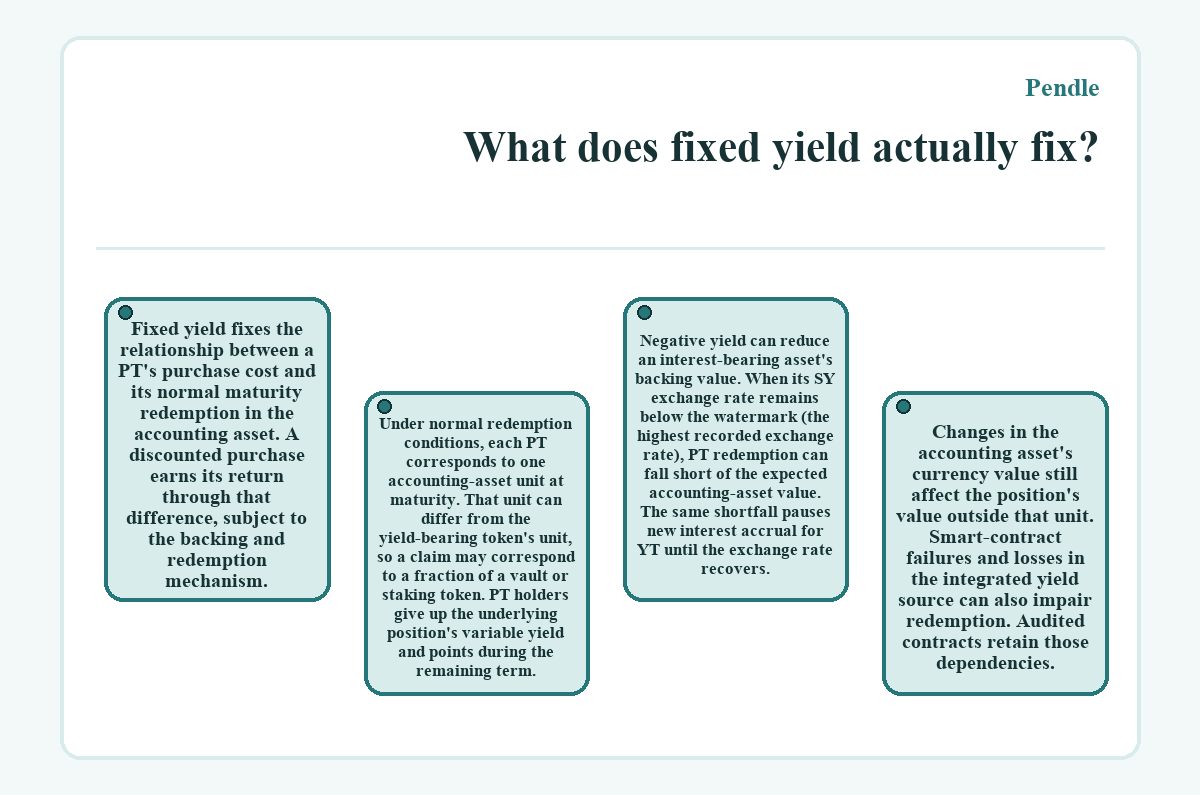
Negative yield can reduce an interest-bearing asset's backing value. When its SY exchange rate remains below the watermark (the highest recorded exchange rate), PT redemption can fall short of the expected accounting-asset value. The same shortfall pauses new interest accrual for YT until the exchange rate recovers.
Changes in the accounting asset's currency value still affect the position's value outside that unit. Smart-contract failures and losses in the integrated yield source can also impair redemption. Audited contracts retain those dependencies.
SY connects staking, lending, and vault yield
Standardized Yield is the wrapper interface through which V2 handles different yield-bearing assets. It standardizes deposits, redemptions, exchange rates, and rewards across supported staking, lending, and vault positions. SY itself has no expiry, whereas the PT/YT pair minted from it has a fixed maturity. Its exchange rate connects wrapper units to accounting value; the raw SY token count does not necessarily equal the quantities of PT and YT minted.
A discounted PT purchase held through maturity
A discounted PT purchase produces a predictable accounting-unit gain at maturity if normal redemption holds. For this hypothetical calculation, assume a confirmed purchase of 173 PT costs 167 accounting-asset units, including trading costs but excluding network gas. The market's accounting asset and actual expiry must be identified before the purchase.
Assume the backing remains intact and the SY exchange rate has no shortfall against its watermark. Holding the position through expiry makes the claim redeemable for 173 accounting-asset units of value. The output may be delivered through yield-bearing tokens, whose token count reflects the applicable conversion.
The accounting-unit gain is 173 - 167 = 6 units, or about 3.59% of the entry cost. This is the total holding-period return before network gas. Annualizing it requires the actual time remaining to maturity. The holder reconciles the received output in accounting-asset units to confirm the principal value.
An exit before expiry replaces this maturity calculation with the available sale quote. Net proceeds below 167 units produce a loss on the position. A different entry cost changes the gain, while a different remaining term changes its annualized rate.
YT prices the yield left before expiry
YT represents future yield and associated rewards from the underlying position during the remaining term. Interest accrues in SY, while separate reward tokens follow the integrated asset's reward mechanism. Protocol fees reduce the income distributed to holders, who can claim accrued amounts before maturity.
Its purchase price represents the cost of acquiring that income stream. YT has no principal redemption at maturity. Economic profit requires realized income and any sale proceeds to exceed acquisition and execution costs. Quoted long-yield returns rely on assumptions about future yield, so a positive underlying rate can coexist with a losing YT position.
YT has no claim on yield generated after its market's maturity. Previously accrued, unclaimed amounts can remain claimable. Where a position earns external campaign points, the campaign's allocation and conversion rules determine whether those points become rewards. Paying for points exposure does not establish their eventual value.
The AMM and limit orders share trade execution
The AMM prices claims with a shrinking remaining term, and its trading curve tightens as maturity approaches. Available liquidity still determines the price impact of an immediate trade.
A PT/SY pool also supports YT swaps
The V2 AMM holds PT and SY in a shared liquidity pool. PT trades directly against SY, while router-managed flash swaps support YT trading through that same pool. The curve concentrates liquidity within a configured implied-yield range, improving execution within that range. Trades that push implied yield farther outside the range can encounter too little pool liquidity to execute.
Limit orders specify an implied yield
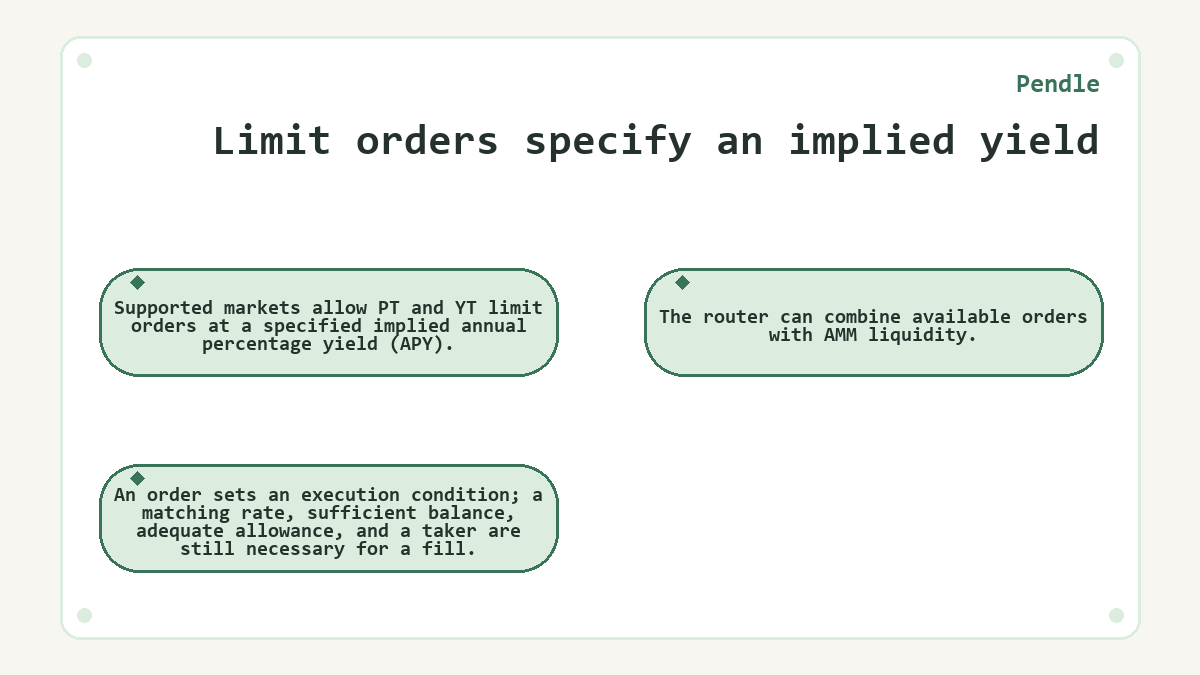
Supported markets allow PT and YT limit orders at a specified implied annual percentage yield (APY). The router can combine available orders with AMM liquidity. An order sets an execution condition; a matching rate, sufficient balance, adequate allowance, and a taker are still necessary for a fill.
Yield-scaled swap costs
Swap costs depend on the market's fee configuration and time remaining until expiry. Extra token conversions can add execution costs, and network gas remains separate. Price impact changes the quote itself, whereas slippage protection limits the deterioration accepted between quoting and execution.
Liquidity provision combines reserves and variable income
Liquidity provider (LP) tokens represent a proportional claim on a pool's PT and SY reserves. Their return combines several exposures, so an LP position requires a different assessment from a standalone principal claim.
Pool reserves change with trading
LP income can include PT's maturity discount, yield from the SY portion, trading fees, and applicable incentives. The reserve mix changes as trades occur. The time-aware AMM reduces time-related price divergence, but market-rate changes and the integrated asset's risks still affect an early withdrawal's value.
Quoted yield components have different assumptions
Underlying APY estimates income from the yield source using recent observations. Implied APY reflects the yield priced into the market. An effective trade rate also reflects the actual execution price. None of these measures alone captures every LP income component. The Algorithmic Incentive Model (AIM) bases LP performance incentives in PENDLE on pool liquidity and fee generation. Separate limit-order incentives reward makers for order-book depth. Co-incentive and discretionary allocations provide additional reward streams. Trading activity and incentive-token values change, so their contribution to a quoted return is variable.
PENDLE and sPENDLE have separate roles
PENDLE is the protocol's native token, while sPENDLE is its staked governance form. They are distinct from the PT and YT claims issued for individual yield markets. Staking issues sPENDLE at a one-to-one token ratio, with rewards distributed separately. For wallet-held sPENDLE, reward eligibility requires voting when a protocol proposal is available. During periods without a proposal, sPENDLE is considered active; sPENDLE held in eligible DeFi integrations remains active even when a proposal is available.
A fee-free cooldown path delays withdrawal, while instant unstaking deducts a fee from returned PENDLE. The contract exposes the applicable cooldown duration and instant-unstaking fee. These terms affect access to the native token independently of any yield market's maturity. New staking uses sPENDLE in place of vePENDLE, while outstanding legacy locks can retain benefits through virtual sPENDLE balances. Those migration benefits follow the legacy position's terms.
Where does Boros fit alongside spot yield trading?
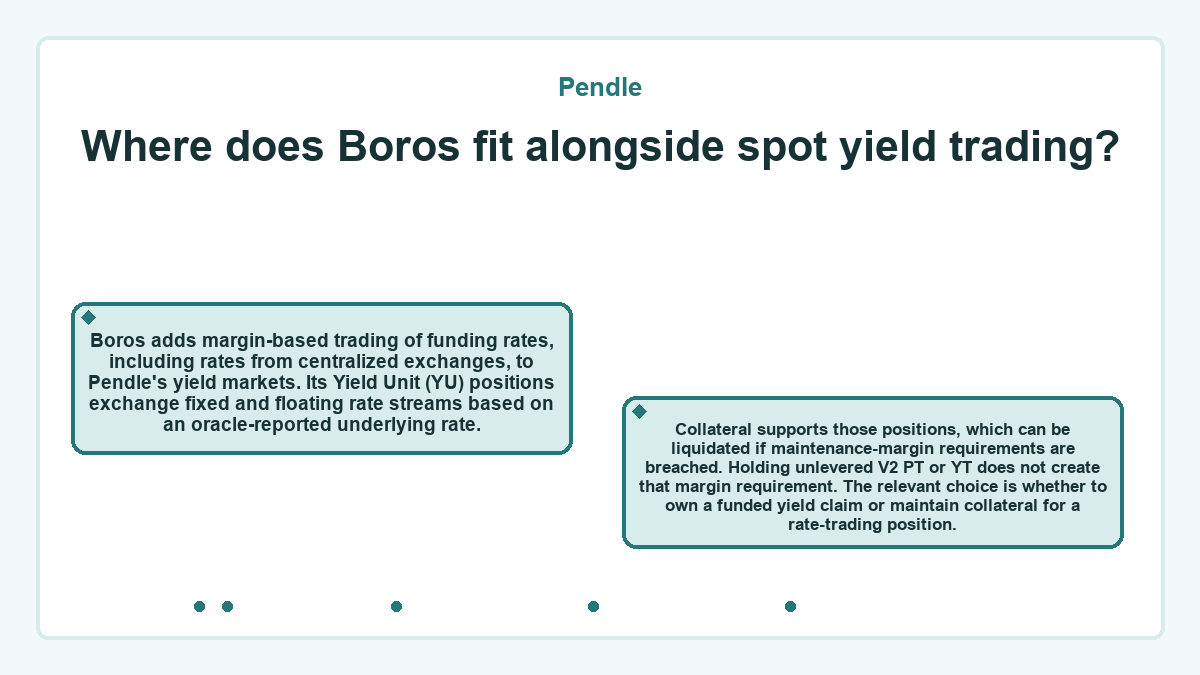
Boros adds margin-based trading of funding rates, including rates from centralized exchanges, to Pendle's yield markets. Its Yield Unit (YU) positions exchange fixed and floating rate streams based on an oracle-reported underlying rate. Collateral supports those positions, which can be liquidated if maintenance-margin requirements are breached. Holding unlevered V2 PT or YT does not create that margin requirement. The relevant choice is whether to own a funded yield claim or maintain collateral for a rate-trading position.
Redemption and an early sale have different exit conditions
Before maturity, selling PT or YT uses available trading liquidity and the prevailing quote. An early PT sale replaces the expected maturity outcome with a market-priced return, including fees and slippage. Matching PT and YT claims from the same asset and expiry can also recombine into SY before maturity. After expiry, principal redemption requires PT without matching YT. Accrued interest and rewards are separate from that principal redemption.
At expiry, pool swaps and new liquidity deposits stop. PT redemption, LP withdrawal, and claims on previously accrued rewards remain available. Choosing another output token can introduce an additional conversion beyond the principal settlement. Leaving matured PT or LP positions unredeemed redirects further underlying yield and points to the protocol's fee wallet. A rollover enters another market with its own maturity, price, and yield-source conditions.
Pendle: common questions
Must I hold PENDLE to buy PT or YT?
Buying PT or YT does not require holding PENDLE for the purchase. The trade uses a compatible input token and the network's gas asset. PENDLE staking belongs to a separate governance and rewards mechanism; it is not a prerequisite for acquiring a principal or yield claim.
Why is my limit order only partly fillable?
A limit order can be partly fillable when the available wallet balance or token allowance covers less than its remaining amount. Those constraints limit what a taker can settle. A zero balance or zero allowance makes the order invalid, even if its specified implied yield matches available trading interest.
Are LP rewards available without staking the LP token?
Native V2 LP token holders accrue their share of applicable rewards without a separate LP-staking step. Reward accrual follows the LP balance, while claiming transfers the accrued amounts. This differs from staking PENDLE for sPENDLE governance benefits.
Is a PENDLE price forecast a forecast of the protocol's yield?
A PENDLE price forecast concerns the native token's market value, while a yield forecast concerns income from a specified yield-bearing asset. PT and YT pricing also reflects the selected maturity and execution conditions. A change in PENDLE's price does not establish whether a YT position will recover its acquisition cost.
Can PT serve as collateral in another protocol?
Some lending protocols accept PT as collateral, subject to the supported market and chain. The lending protocol determines borrowing limits, valuation, and liquidation rules. A maturity-based principal claim does not prevent an external loan from being liquidated if the collateral position breaches that lender's risk limits.
Does viewing market data require a connected wallet?
The public market-data API can be queried without a wallet connection. Reading available markets and yield data does not authorize token spending. Buying claims, minting tokens, and changing liquidity require the relevant on-chain transactions and permissions, which are separate from retrieving market information.
How are existing vePENDLE locks treated under sPENDLE?
Existing vePENDLE locks can generate a nontransferable virtual sPENDLE balance during the transition. Its benefits depend on the snapshotted locked amount and remaining lock time, and expire at full unlock. Continuing with wallet-held sPENDLE requires redeeming unlocked PENDLE and staking it; the legacy lock does not automatically become a transferable staking token.