 Pendle
Pendle enables margined funding-rate trading through Boros
Pendle extends its yield-trading offering through Boros, where collateral backs fixed-for-floating swaps on perpetual futures funding rates. Yield units (YU) measure the funding exposure. Long positions pay a fixed rate and receive floating funding; short positions receive fixed and pay floating. Matching a swap to an existing perpetual position can stabilize its funding component through maturity. The hedge remains exposed to mismatched notional amounts, independent margin requirements, and premature closure.
· last updated
Matching funding exposure can stabilize its cost through maturity, while separate margin requirements can force a hedge to end early.
YU connects funding streams with fixed-rate trading
A YU position combines an agreed fixed rate with exposure to the funding stream of a referenced perpetual market. Each YU represents funding on one unit of the market's collateral asset; the collateral deposited to back the position is a separate balance. The market defines the denomination and maturity. A standalone YU position expresses a view on rates, while pairing it with a perpetual adds a funding hedge.
Paying fixed to receive floating
A long position benefits economically when accumulated floating funding exceeds its fixed obligation, before fees. Rising implied rates can also improve its value before expiry. Falling implied rates work against its margin, even when the position belongs to a broader hedge.
Receiving fixed to pay floating
A short position exchanges floating funding exposure for a fixed receipt. It can stabilize the funding income of a matched perpetual position. Persistently higher floating funding creates losses on the swap, while falling implied rates improve its mark-to-market value.
The selected Boros market determines collateral and maturity
Each Boros market specifies its reference rate, collateral denomination, and maturity, so a hedge starts with matching those terms. Boros is deployed on Arbitrum. Opening exposure requires sufficient collateral in the applicable account and a market that permits the trade. Collateral backing an external perpetual position remains separate from Boros margin. A submitted order establishes a request; its actual fill establishes the exposure and entry rate.
Order-book fills establish the entry rate
The filled order's average implied annual percentage rate (APR) determines the fixed rate attached to that exposure. A resting limit order specifies an acceptable rate and can remain unfilled or fill partially. The order book prioritizes better rates, then earlier orders at the same rate. Available depth determines how much size can execute without moving through additional rate levels.
An automated market maker (AMM), where attached and active, provides another source of liquidity. Supported single-order routing can combine the book and AMM; bulk order-book operations do not automatically access AMM liquidity. An AMM can stop quoting outside its active range or after its cutoff. Its presence does not ensure that the entire requested position will fill.
Funding settlements and mark valuation use different rates
The external funding rate drives floating payments, while Boros's mark implied APR determines unrealized position value and margin calculations. The mark implied APR is a time-weighted average of traded rates on the Boros order book. It can differ from the latest fill or displayed midpoint. The underlying funding stream comes through an oracle, independently of the book's pricing.
Contract accounting books the fixed leg upfront when a trade settles: a long pays it, and a short receives it, with payment signs reversing for negative fixed rates. Floating payments accrue through the funding index and settle periodically.
Settlement timing follows the referenced market's funding schedule. Adverse floating payments can erode the collateral buffer even without a change in the mark rate.
What does Boros fix when hedging a perpetual position?
Boros can fix the matched funding component through the swap's maturity, provided the reference rate and equivalent exposure remain aligned. Asset-price profit and loss remain with the perpetual position.
A funding payer pairs that obligation with a long YU position that receives the same floating stream. A funding recipient pairs its income with a short YU position that pays floating. The fixed leg then supplies the economic cost or receipt for the matched exposure.
Matching requires the same reference stream, compatible denomination, equivalent notional, and overlapping funding settlements. A rate from another market can diverge. Changes to the perpetual's size leave some funding exposure unmatched unless the swap exposure changes correspondingly.
The same mechanism supports spread trades across perpetual markets. A short swap can fix the higher funding receipt, and a long swap can fix the lower funding payment. The resulting differential still carries execution costs and the operating risks of each position.
Both systems retain their own margin requirements. A favorable combined funding outcome cannot prevent liquidation of a leg whose collateral becomes insufficient.
Cross margin and isolated margin contain risk differently
Cross margin shares collateral across markets within one collateral zone; isolated margin confines it to one market. The permitted mode belongs to the selected market and account configuration. Some markets require isolation.
A shared collateral zone
Profits in one cross-margin position can support another position in the same collateral denomination. Losses can also consume that shared buffer, affecting other exposure in the zone. Separate collateral zones remain isolated from each other. This pooling changes where available margin comes from; it does not cancel the portfolio's rate risk.
A market-specific allocation
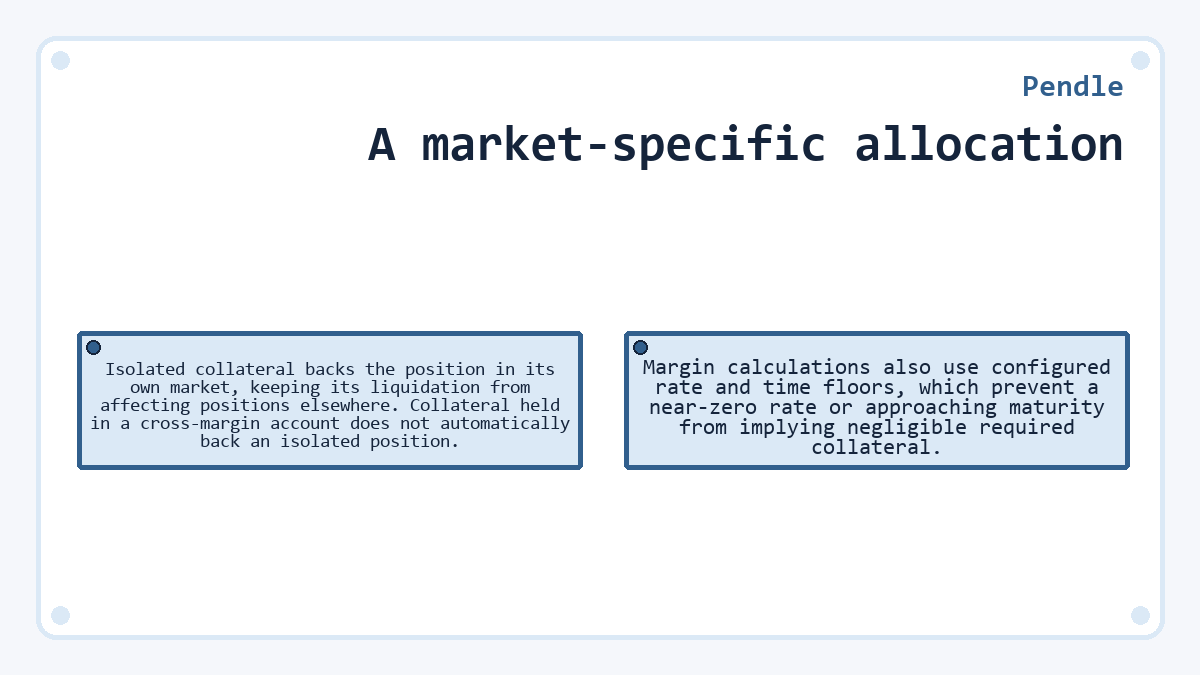
Isolated collateral backs the position in its own market, keeping its liquidation from affecting positions elsewhere. Collateral held in a cross-margin account does not automatically back an isolated position. Margin calculations also use configured rate and time floors, which prevent a near-zero rate or approaching maturity from implying negligible required collateral.
Rate sensitivity links notional size to the remaining term
A one-percentage-point APR move has a larger effect on position value when notional exposure or time to maturity is greater. Rate sensitivity equals absolute YU notional multiplied by remaining years and 0.01. For unchanged notional, rate sensitivity decreases as maturity approaches. Margin requirements also incorporate market factors and floors. Recent rate volatility gives context for the collateral buffer, without placing a ceiling on future adverse movements.
A matched funding payer leaves a fixed-rate cost
Consider a hypothetical funding payer matched to a long position of 173 YU. Its market terms, rates, funding outcomes, and time inputs are hypothetical. Before entry, eligible collateral is sufficient in the required margin account, and the market permits new exposure. The perpetual and swap share the funding reference and equivalent collateral-denominated notional, with both exposures remaining open across the same settlement window through maturity.
Let f denote a positive filled annual fixed rate expressed as a decimal, T the term in years from the market's last settled funding boundary to maturity, and I the accumulated floating funding fraction. The long order fills for the full 173 YU; an unfilled remainder would leave that part of the funding exposure uncovered.
The perpetual pays 173 × I collateral units over the matched window. The Boros long receives 173 × I and pays the fixed leg of 173 × f × T upfront. Combined funding therefore costs 173 × f × T before fees. The filled size, reference market, and corresponding floating settlement amounts would confirm the intended offset.
A changed notional, a different reference rate, or either leg ending early invalidates that offset for the affected period. A fall in the mark implied APR can reduce the Boros long's net balance despite the funding offset.
Trading and carrying costs have separate drivers
Order-book taker fees scale with absolute position size, the configured fee rate, and remaining maturity expressed in years. Resting maker fills avoid that taker charge. An AMM fill can incur its own liquidity-provider fee alongside the protocol's over-the-counter swap fee. Those charges have distinct calculation rules, so a protocol fee alone does not describe the full AMM cost.
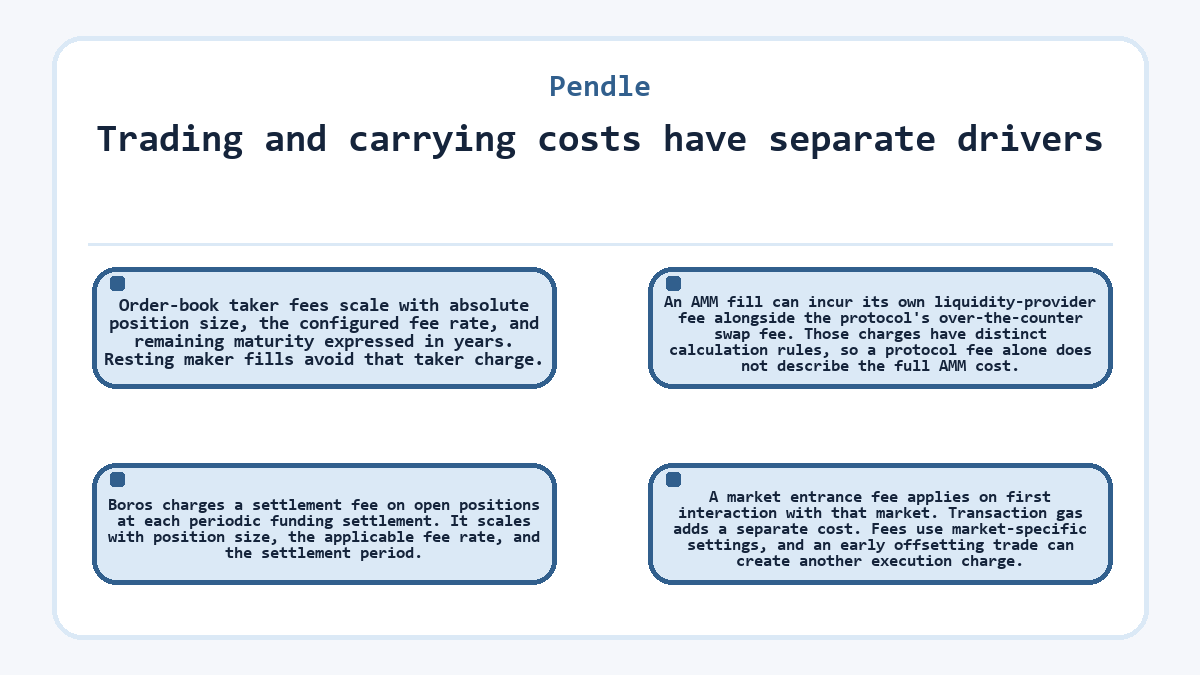
Boros charges a settlement fee on open positions at each periodic funding settlement. It scales with position size, the applicable fee rate, and the settlement period. A market entrance fee applies on first interaction with that market. Transaction gas adds a separate cost. Fees use market-specific settings, and an early offsetting trade can create another execution charge.
Expiry and an offsetting trade end exposure differently
At maturity, the funding stream ends and the position's final settlement is reflected in collateral. Closing earlier requires an opposing trade against the existing size. The floating legs cancel for the closed amount, and the difference between the fixed legs is settled into collateral. A smaller opposing trade leaves the unmatched remainder open. The exit rate and available liquidity determine the early-close outcome.
Required margin is released as exposure ends. Withdrawal remains a separate operation with a request, cooldown, and finalization process; expiry does not send funds automatically to a wallet.
Liquidation and emergency controls can interrupt a hedge
A position becomes eligible for liquidation when net balance, including collateral and unrealized profit or loss, falls below maintenance margin for its cross-margin zone or isolated market. Liquidation can transfer some or all exposure to a liquidator at the mark rate. A liquidator incentive and a separate protocol liquidation fee can reduce the remaining collateral.
Order controls before liquidation
Permissioned risk bots can cancel resting orders as account health deteriorates or remove orders outside permitted rate bounds. Cancellation removes unfilled exposure requests; it does not close an existing position.
Restrictions on immediate exits
Open-interest controls can restrict new taker exposure. More severe makers-only conditions can disable taker exits as well, while a market halt can suspend trading and cancellations. Consequently, posting an exit request does not assure immediate closure during market stress.
Auto-deleveraging of opposing positions
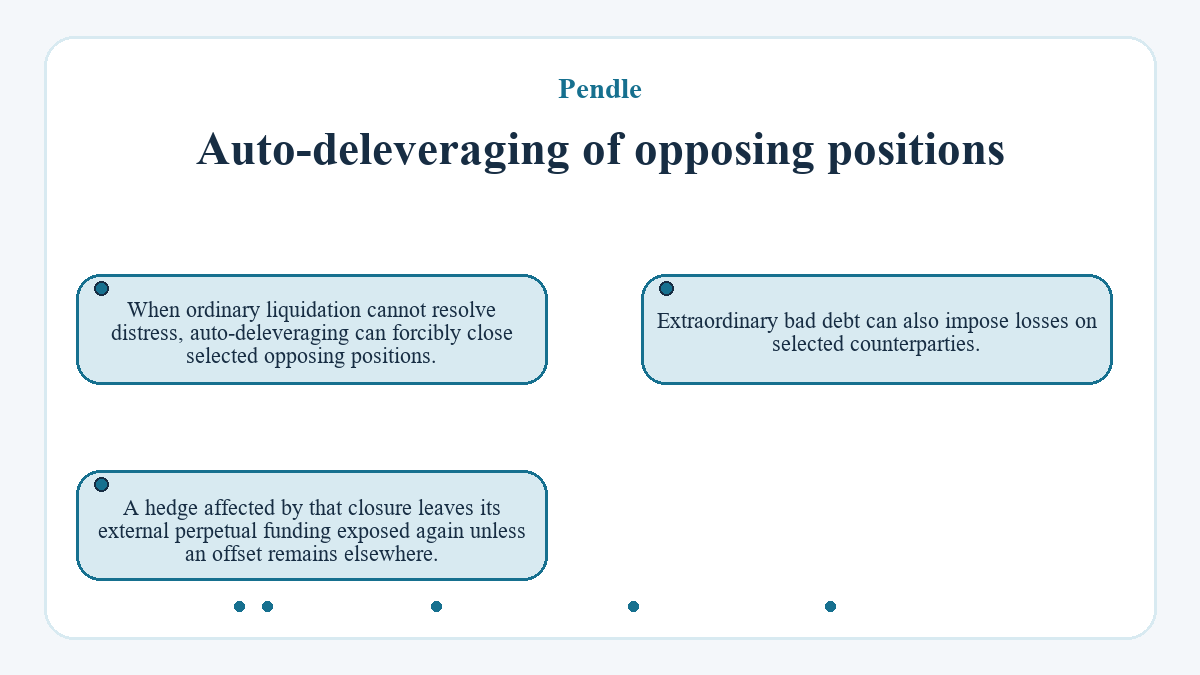
When ordinary liquidation cannot resolve distress, auto-deleveraging can forcibly close selected opposing positions. Extraordinary bad debt can also impose losses on selected counterparties. A hedge affected by that closure leaves its external perpetual funding exposed again unless an offset remains elsewhere.
Pendle: questions and answers
Is Boros implied APR a compounded APY?
Boros expresses rates as simple annual percentage rates, not compounded annual percentage yields. The quoted rate applies to the relevant notional and remaining term. It is not a return percentage on deposited margin, because the funding exposure can exceed the collateral that backs it.
Why does my limit-order APR differ slightly from the rate I entered?
The order book represents rates using discrete ticks, so a requested APR may require rounding to a valid level. Tick spacing depends on the market. An AMM quote uses a continuous rate and need not coincide with an available order-book tick.
Does a resting limit order consume available margin before it fills?
Resting orders enter the initial-margin calculation before they fill. Boros assesses the possible exposure if orders execute, alongside existing positions. An order that only reduces exposure can receive different treatment from one that adds exposure or flips the position, so reserved margin is not simply proportional to every posted order.
Will adding collateral change my Boros rate sensitivity?
Adding collateral increases the buffer against losses without changing rate sensitivity for the same position size and remaining maturity. Rate sensitivity falls when notional size decreases or the remaining term shortens.
What happens to an old closing order after a manual position reduction?
A separate closing limit order keeps its original size unless cancelled or adjusted. If its eventual fill exceeds the remaining position, it can close that remainder and create exposure in the opposite direction.
When can a funding settlement arrive after its scheduled boundary?
Floating settlement can arrive after the funding boundary because it depends on an off-chain oracle update. Extreme volatility or a settlement that threatens account health can introduce further delay while risk operations run. The funding boundary and the moment the update executes are distinct; a delay alone does not establish a missed payment.
Are negative implied rates tradable through every Boros AMM?
Negative implied-rate trading depends on the AMM curve attached to that market. A negative-rate AMM can quote across zero; a positive-rate AMM uses a non-negative range. The order book supports negative rate levels, subject to market bounds. The underlying floating funding stream can have a different sign from the swap's fixed rate.
Which record explains a position reduction caused by auto-deleveraging?
An auto-deleveraging event is generally recorded in the Trade History tab. The record identifies the quantity closed, the mark implied APR at closure, and any bad debt absorbed, with ADL given as the reason. This distinguishes a forced reduction from an ordinary fill, including when only part of the position closes.