 Pendle
Pendle principal tokens for fixed yield and maturity redemption
Pendle principal tokens (PT) separate a yield-bearing asset's principal claim from its future yield until a specified maturity date. Buying below the claim's accounting-asset value establishes a fixed holding-period return if redemption remains intact. The payout depends on the market's accounting unit, backing, and available redemption assets.
· last updated
Holding to maturity or retaining variable yield
The remaining term determines how long a PT holder must wait for principal redemption without selling the claim on the market. A discounted purchase held through maturity fixes the relationship between acquisition cost and the principal claim, subject to intact backing. Holding an unsplit yield-bearing asset preserves exposure to its changing yield. Yield tokens (YT) receive the separated pre-expiry yield and associated underlying rewards and points. PT alone gives up those entitlements. The relevant choice is whether the position should retain that variable income or exchange it for a maturity-based claim.
An earlier cash requirement introduces a market-priced exit and makes sale liquidity relevant to the position.
PT purchases and paired minting
Buying existing PT acquires principal exposure directly, while minting creates principal and yield claims together from a supported asset. These routes produce different balances.
Acquiring the principal claim
A PT purchase does not require ownership of its matching YT. Pendle's V2 automated market maker (AMM) trades PT against Standardized Yield (SY), the wrapper for the yield-bearing asset. Supported routing can convert an input token into the required asset along the way. The acquired PT quantity and the actual acquisition cost determine the entry economics.
Splitting the wrapped asset
Minting deposits SY into the yield-tokenization contract, which creates equal quantities of PT and YT. The PY index, which tracks the SY exchange rate without decreasing, determines those quantities. One SY need not produce one token of each kind. Retaining both claims preserves principal and yield exposure; selling YT monetizes the future yield entitlement while leaving PT principal exposure.
Principal exposure across position choices
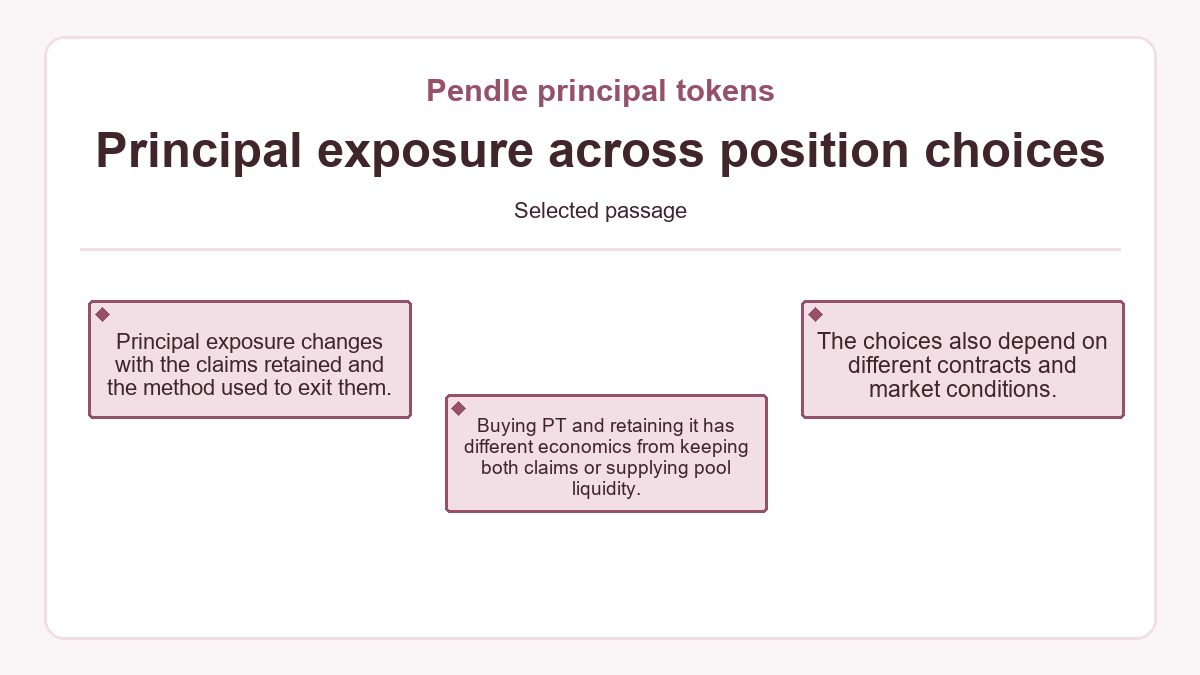
Principal exposure changes with the claims retained and the method used to exit them. Buying PT and retaining it has different economics from keeping both claims or supplying pool liquidity. The choices also depend on different contracts and market conditions.
| Choice | What it retains | Return or exit basis | Dependency or loss exposure |
|---|---|---|---|
| Buy and retain PT | Principal claim | Purchase discount to maturity redemption | Underlying asset and SY backing |
| Mint a pair and sell YT | PT plus YT sale proceeds | Monetized yield entitlement and later principal redemption | YT execution price and principal backing |
| Retain matching PT and YT | Principal and pre-expiry yield claims | Paired redemption before expiry | Matching SY and expiry; underlying asset risk |
| Sell PT before expiry | Proceeds from the sale | Executable market price | Liquidity, price impact, and available routing |
| Redeem matured PT | Principal output through SY | Contract redemption after expiry | Backing and supported output conversion |
| Hold the yield-bearing asset unsplit | Principal and variable yield exposure | The asset's own holding and withdrawal mechanics | Underlying protocol and withdrawal conditions |
| Provide PT/SY liquidity | A share of the pool's reserves | Pool income and liquidity removal | Pool composition, rate changes, and asset backing |
| A maturity claim, a market sale, and a liquidity position have different return and exit conditions; after a sale or redemption, asset exposure depends on the token received. | |||
Pool income can include swap fees and incentives where offered, alongside exposure to PT and SY. Its combined return varies. A pool share therefore cannot substitute for a stated quantity of PT in a fixed-return calculation.
Principal redemption and output conversion
Maturity changes which claims the yield-tokenization contract must burn, while the underlying asset remains wrapped inside the selected SY. Redemption settles the principal claim against that backing.
Before and after expiry
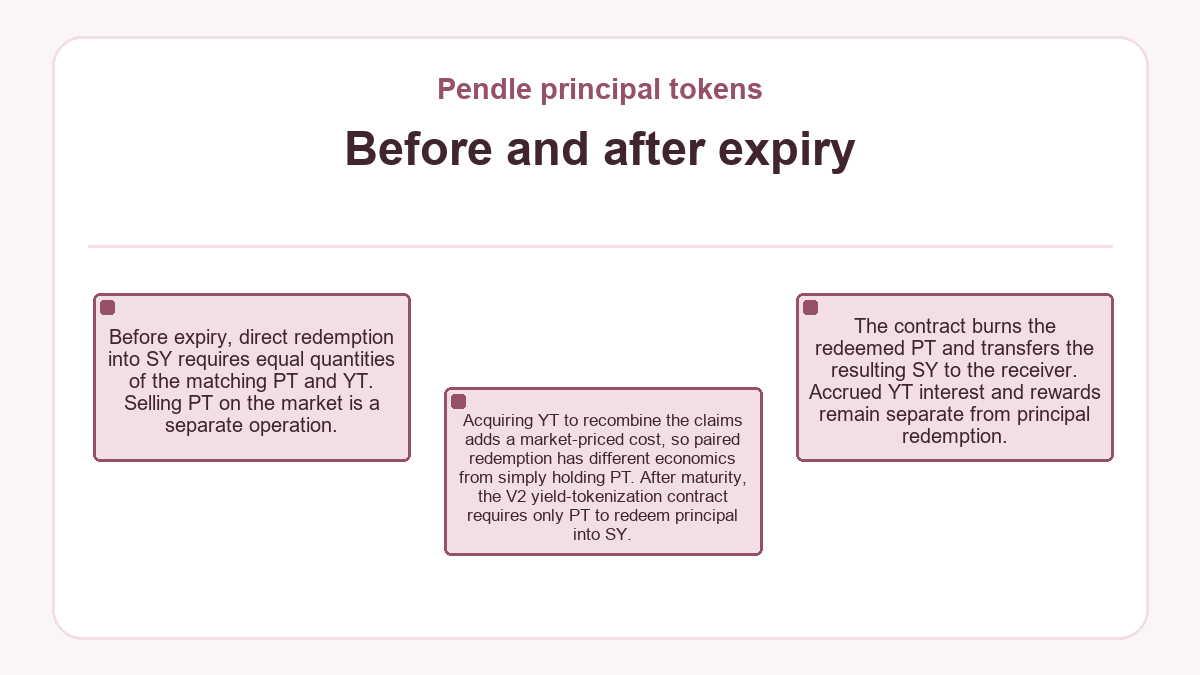
Before expiry, direct redemption into SY requires equal quantities of the matching PT and YT. Selling PT on the market is a separate operation. Acquiring YT to recombine the claims adds a market-priced cost, so paired redemption has different economics from simply holding PT.
After maturity, the V2 yield-tokenization contract requires only PT to redeem principal into SY. The contract burns the redeemed PT and transfers the resulting SY to the receiver. Accrued YT interest and rewards remain separate from principal redemption.
The token received
Unwrapping SY delivers an output token that its adapter supports. An additional swap can provide another asset when an executable route exists. The router can combine these operations within a transaction; their conceptual separation does not require separate wallet transactions.
The accounting asset identifies the claim's denomination, while the output token identifies what arrives in the receiving wallet. A yield-bearing output can carry its own withdrawal rules. PT maturity therefore does not establish immediate access to every asset that could ultimately be withdrawn.
The accounting asset and the fixed-return calculation
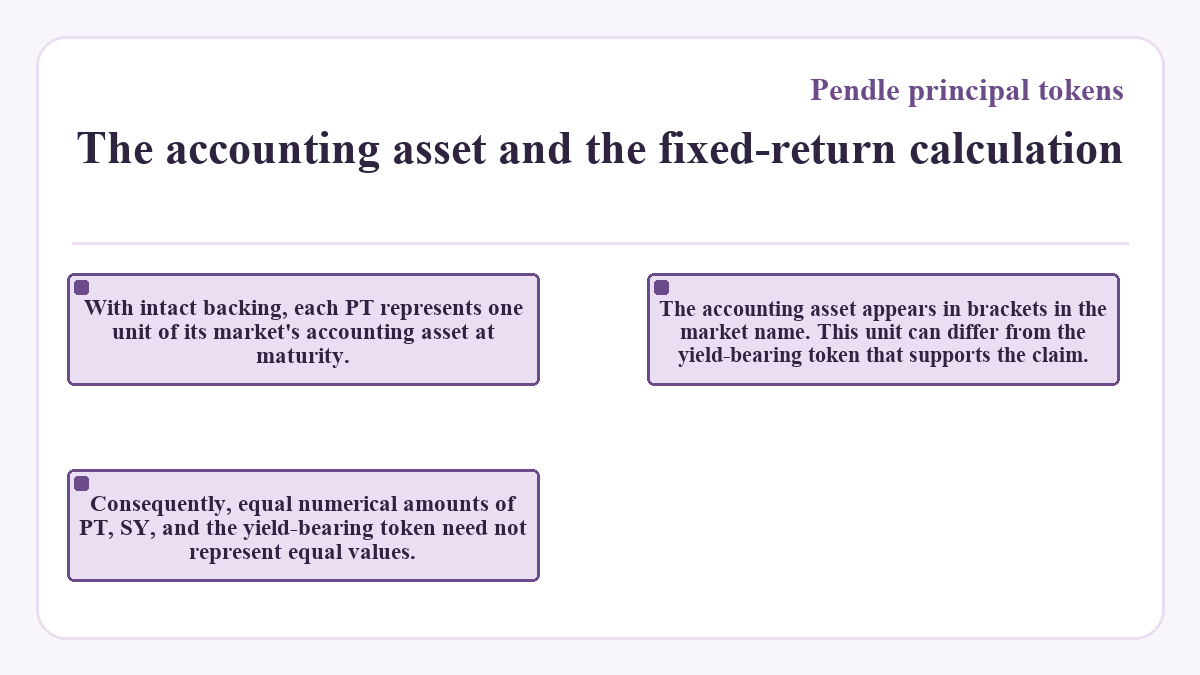
With intact backing, each PT represents one unit of its market's accounting asset at maturity. The accounting asset appears in brackets in the market name. This unit can differ from the yield-bearing token that supports the claim. Consequently, equal numerical amounts of PT, SY, and the yield-bearing token need not represent equal values.
Return over the remaining term
Let C be the acquisition cost and R the expected maturity redemption value, both expressed in accounting-asset units. The holding-period return before subsequent exit costs is R / C - 1. This measures the gain over the actual remaining term. A positive purchase discount produces a positive return only if the assumed redemption value survives.
Annualized yield and asset value
For d days remaining, the corresponding annualized yield is (R / C)^(365 / d) - 1. Annual percentage yield (APY) expresses that relationship on an annual basis. The actual holding-period gain follows the remaining term, which can be shorter or longer than a year. A fixed return in accounting-asset units also leaves the asset's dollar price free to change.
Rate changes and an early PT sale
Before maturity, a higher market-implied yield corresponds to a larger PT discount for the same remaining term and principal value. Rising implied yields can therefore lower the early sale price; falling yields can raise it. The V2 AMM adjusts its curve as expiry approaches, but executable prices still reflect liquidity and trade size. A pool outside its configured yield range can lack liquidity for a trade in the affected direction. An early sale realizes the available price after costs, rather than the maturity return established at purchase.
The watermark and losses in principal backing
An SY exchange rate that remains below its recorded watermark can reduce PT redemption value at maturity. The watermark is the highest exchange rate recorded through the PY index. That index does not decrease when the asset experiences negative yield. If each unit of backing loses value against the accounting asset, the corresponding principal claim can deliver fewer accounting-asset units. YT interest accrual also pauses while the rate remains below the watermark. Ordinary changes in positive yield and a drawdown in backing therefore have different consequences.
A stablecoin depeg creates another route to loss: the accounting asset can lose dollar value even when token-denominated redemption remains intact. Contract failures can affect the SY wrapper or the underlying yield protocol. Some SY implementations also depend on exchange-rate oracles; an erroneous upward rate can inflate the stored watermark. These dependencies matter because PT separates the income entitlement without replacing the asset or contracts that support principal redemption.
Matching PT, YT, and SY contracts
A PT belongs to a particular SY and immutable expiry, with the factory registry identifying its corresponding YT contract. Equal-looking names do not make claims from different maturities interchangeable. Paired redemption requires the actual matching contracts on the relevant blockchain. The SY interface separately defines acceptable deposit and redemption tokens; those lists can differ. Its accounting asset may be a reference unit rather than a token directly available on that chain. Contract identity and output compatibility establish the relevant claim more reliably than a shared ticker.
Execution costs and effective fixed yield
The effective fixed APY for a PT trade reflects its acquisition price after price impact and swap fees. The market's displayed rate can differ from that executable quote, particularly when a trade consumes limited liquidity. Pendle's AMM swap fee scales with the remaining term and the market's fee setting. Routed token conversions can introduce additional costs. Network gas is another expense and does not form part of the principal claim. Comparing cost and redemption value requires a consistent denomination for both amounts.
Matured PT principal redemption carries no Pendle protocol redemption fee, although gas remains payable. A separate swap or an underlying asset withdrawal can add its own costs or constraints. Quoted minimum output protects the selected transaction by causing a revert when execution cannot satisfy it. A spending approval grants permission; it does not establish a completed purchase or redemption. The receiving balance and transaction execution establish the acquired or redeemed amount. Net proceeds remain limited by the actual output route and its costs.
Pendle principal tokens - common questions
Will transferring PT to another wallet restart its maturity period?
Transferring PT leaves its maturity date unchanged. Expiry belongs to the token contract, not the wallet that holds it or the date of acquisition. The recipient receives the remaining term of the same principal claim. Moving the token also leaves its SY backing and accounting denomination unchanged.
Does fixed PT yield arrive as daily wallet payments?
A standalone PT holding does not pay its fixed yield as daily interest transfers. Its return comes from the difference between acquisition cost and maturity redemption value, subject to backing and costs. The PT quantity does not automatically grow with passing time, so an unchanged token balance can still represent a discounted maturity claim.
Is a matured PT automatically reinvested in a later market?
A matured PT does not automatically become a claim in a later market. Pendle's Roll Over operation requires a selected destination market and a successfully executed transaction. Entering that market establishes new acquisition economics and a new maturity. Leaving the old PT unredeemed does not extend its original fixed-yield term.
Why can an accepted deposit token still fail to mint PT?
A token's inclusion in an SY adapter's accepted-input list does not remove the underlying protocol's operating constraints. Capacity limits, minimum deposit requirements, or unavailable liquidity can prevent the deposit that must precede PT minting. An unsupported input is a compatibility problem; a supported input can still encounter a temporary or amount-dependent restriction.
Are EIP-2612 permit approvals available for every PT deployment?
PTs created through V4 and later factories do not support EIP-2612 permit approvals. The ordinary ERC-20 approve function grants an allowance separately from redemption. A permit signature cannot set an allowance on a token that omits that function. Earlier deployments can expose a different interface.